
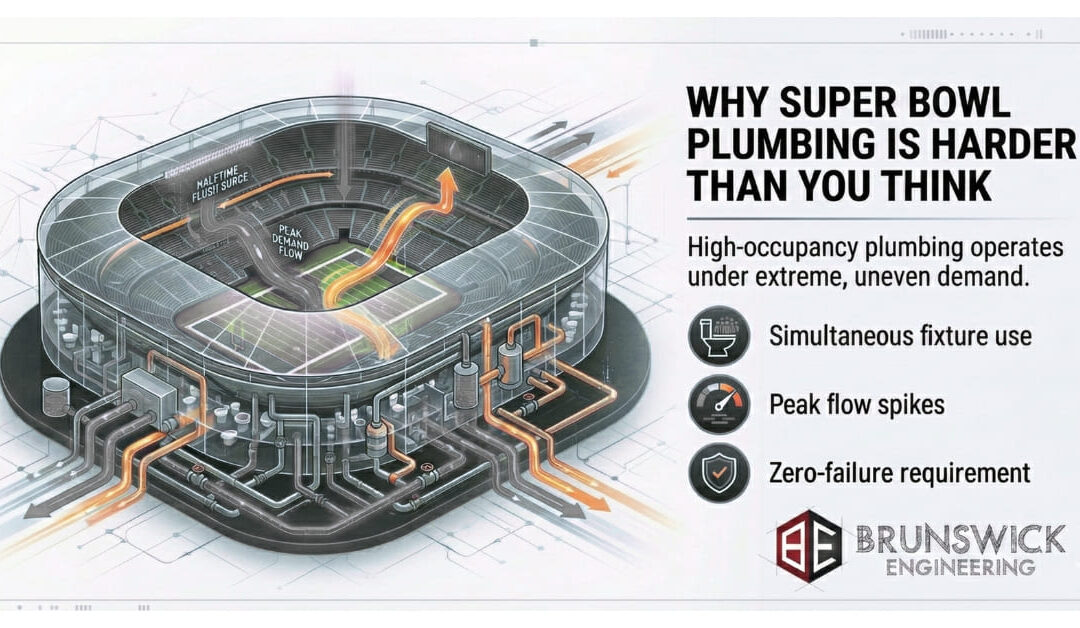
It’s halftime at the Super Bowl. You’ve been holding it since the second quarter because there’s no way you’re missing that touchdown. The whistle blows. You and 70,000 other people have the exact same idea at the exact same time.
You rush to the bathroom. You flush. Water swirls away like it does every other day of your life.
What you don’t see: Somewhere in the bowels of the stadium, an engineer just watched their pressure gauge drop like a stone and reached for the emergency pump controls.
Welcome to the halftime flush, the single most intense plumbing event in America.
Here’s What Really Happens
You see, during a normal quarter, the stadium uses maybe 200 gallons of water per minute. People trickle to the bathroom during commercials, grab drinks, and wash their hands. The plumbing system handles it easily.
Then halftime hits.
Within three minutes, water usage can spike to 1,000 gallons per minute. That’s a 500% increase. Imagine your garden hose suddenly trying to pump five times more water through the same pipe. Something’s got to give.
And when plumbing fails in a stadium with 70,000 people? You’ve got:
- Toilets that won’t flush
- Sinks with no water
- Backed-up drains
- Smells you definitely don’t want
- Thousands of very unhappy fans
This is every engineer’s nightmare.
The Hidden Engineering
So how do you stop a disaster when everyone flushes at once?
1. Pumps That Wake Up Fast
Normal water pumps are like light switches on or off, nothing in between. That doesn’t work when you need to go from “lazy Sunday” to “full emergency” in 30 seconds.
Modern stadiums use smart pumps that can ramp up speed instantly. Think of them like your car’s gas pedal; you can go from idle to full throttle in one smooth motion.
When sensors detect pressure dropping (because thousands of toilets just flushed), the pumps automatically speed up to compensate. No human intervention needed. The system just… handles it.
2. Pipes Bigger Than You’d Believe
We’re talking waste pipes 10 to 12 inches wide. You could crawl through them.
But here’s the weird part: big pipes alone don’t solve the problem.
When water rushes down a drain, it pushes air. That air needs somewhere to go. Without proper venting, you get either:
- Sewage burping back up through lower toilets (yes, really)
- A vacuum that sucks all the water out of the drain traps, letting sewer gas into the building
So stadiums have a second, parallel set of pipes just for air movement. These “vent stacks” let the system breathe while thousands of gallons are draining at once.
It’s like having two straws in your milkshake, one to drink, one to let air in so you don’t collapse the cup.
3. Massive Electrical Backup
Here’s something most people never think about: modern plumbing needs electricity.
Those smart pumps? They’re each drawing enough power to run several houses. When multiple pumps kick on during halftime, the electrical demand spikes by 500+ kilowatts in seconds.
If the power fails, the plumbing fails. Period.
That’s why stadiums have backup generators that can come online in under 10 seconds. The pumps barely notice the switch.
Why You Should Care (Even If You Don’t Own a Stadium)
“Okay,” you’re thinking, “but I’m never building a stadium. Why does this matter to me?”
Because every building has a halftime moment.
- Your office building? Monday morning at 8 AM when everyone arrives, makes coffee, and hit the bathroom before their first meeting.
- Your apartment building? Every weekday at 7 AM when 200 people are showering before work.
- That hospital down the street? When the night shift and day shift overlap, suddenly, there are twice as many people using the facilities.
- The data center storing your photos? When everyone streams the Super Bowl simultaneously, servers spike from 40% to 95% capacity (generating massive heat that needs instant cooling).
The lesson is the same everywhere: Buildings designed for “average” use fail during peak moments.
And peak moments are exactly when you can’t afford failure.
The Invisible Success
Nobody tweets about how well the toilets flushed at halftime.
No one writes a Yelp review saying, “Consistent water pressure throughout the event 5 stars!”
When plumbing works perfectly, it’s completely invisible. You use the bathroom, wash your hands, and get back to your nachos without a second thought.
But when it fails? Everyone notices. And everyone remembers.
That’s the engineer’s burden: you’re only noticed when things go wrong.
This Sunday, Spare a Thought
When you watch the Super Bowl this weekend and the halftime show starts, picture this:
While you’re watching the performance, somewhere deep in that stadium, pumps are spinning up. Sensors are monitoring pressure. Backup systems are standing ready. Engineers are watching dashboards, ready to intervene if needed.
Seventy thousand people are about to flush simultaneously.
And the system is ready.
Because somewhere, years ago, an engineer asked: “What’s the worst that could happen?” And then they designed for exactly that.
The toilets will flush. The water will flow. The fans will return to their seats without ever knowing how close they came to disaster.
That’s not luck.
That’s engineering.
Is Your Building Ready for Its Worst Day?
Your building might not host the Super Bowl, but it has its own peak moments, times when demand spikes and failure isn’t an option.
We design plumbing, electrical, and mechanical systems that work when it matters most. Not just on average days. On your worst days.
If you’re building something new or worried about an existing facility, let’s talk. We’ll find your building’s “halftime moment” and make sure your systems are ready for it.
Because good engineering means you never have to think about the plumbing.
Contact us to stress-test your building’s infrastructure before peak demand finds the weak spots.