
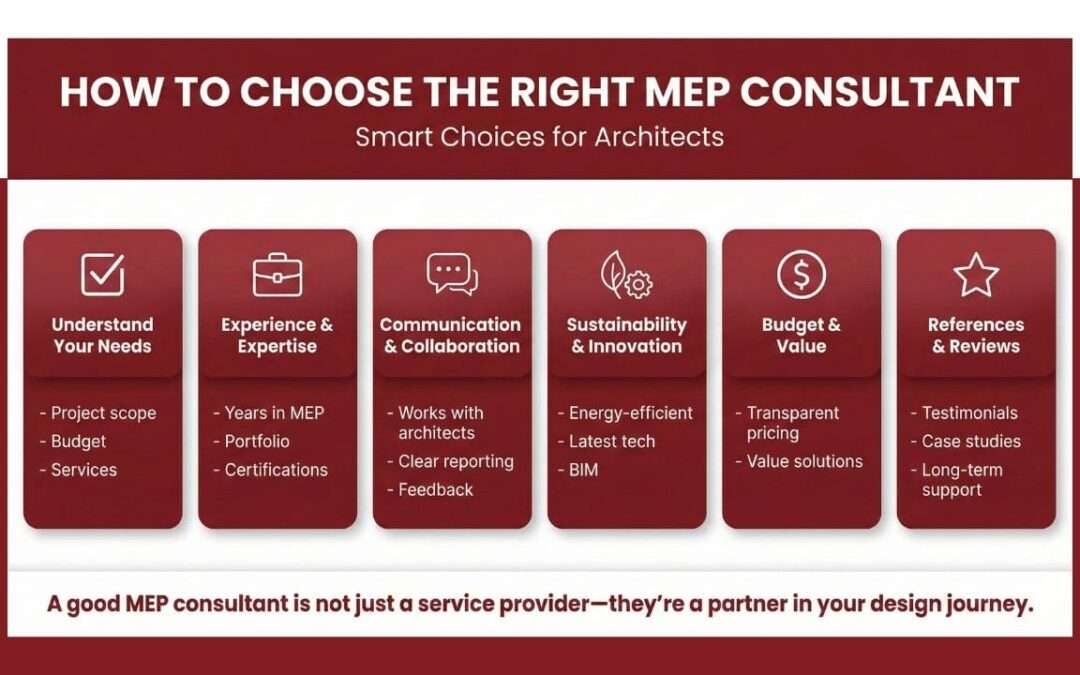
If you’ve ever had an MEP consultant come back with a design that clashes with your architectural intent, blows the budget, or causes a chaotic construction coordination period, you’re not alone.
MEP (mechanical, electrical, plumbing, and fire) mistakes are expensive. They cause redesigns, RFIs, delays, and unhappy clients. The good news is that most of those mistakes are preventable. Selecting the right MEP consultant early makes all the difference. This guide provides a practical, step by step system (complete with checklists and specific questions to ask) to help you hire an MEP partner who delivers on time, on budget, and without headaches.
I’ve broken this down into 10 clear steps. Each one is something you can use on your next project. Read the intro. Skim the checklist. Use the templates. Done.
Quick TL;DR (If you’re skimming)
- Define scope clearly before you approach MEP firms.
- Hire for relevant experience (not generalists).
- Verify BIM & clash detection skills.
- Confirm code knowledge, QA processes, and communication workflows.
- Focus on value, not lowest fee.
- Run a pilot task or short interview exercise before signing.
1) Start with the project scope and don’t be lazy about it
Most mistakes come from fuzzy scope. Before you shortlist anyone, write a short but specific project brief. This forces you (and them) to be on the same page from day one.
What to include in your Project Scope (one page):
- Building type and footprint (GFA, floors).
- Target performance goals (e.g., Net Zero ready; LEED Gold; energy use target).
- Primary systems required (HVAC type; central plant; chilled beams; VRF; district cooling).
- Special requirements: lab exhaust, medical gas, kitchen extraction, resilient electrical feed, standby generators, fire suppression type.
- BIM deliverable level (LOD 200/300/350?).
- Critical timeline milestones (SD, DD, CD, BOD).
- Who does site coordination/inspection?
Why this helps: when firms respond, you can see who actually understood your constraints. If a proposal is generic red flag.
2) Hire for relevant experience, not just size or prestige
An MEP firm that “does everything” is tempting, but specialization wins.
Ask for case studies that match:
- Building type (hospital vs. high rise vs. industrial).
- Similar scale and complexity.
- Examples showing value engineering or problem solving.
When reviewing portfolios, look beyond pretty visuals:
- Were the projects completed on time?
- Did they reduce lifecycle costs?
- Do they show coordination with architectural intent (photos of installed systems integrated with ceiling/plenum, penetrations, etc.)?
If they can’t show similar examples, move on.
3) Technical capability: software, modeling, and clash detection
Today’s MEP work is BIM driven. If they’re still treating Revit like an optional tool, you’ll pay later.
Key technical capabilities to verify:
- Revit + Navisworks + BIM 360 or similar collaboration platform.
- Energy modeling tools (e.g., EnergyPlus, IES, eQUEST) if performance targets are set.
- Load calculation software (e.g., HAP, TRACE).
- Electrical sizing and short circuit/coordination analysis capability.
- Clash detection workflow how often, what tolerance, who resolves clashes.
Questions to ask:
- “What LOD do you deliver at each stage?”
- “How often do you run clash detection, and what’s your process for resolving clashes?”
- “Can you share a sample clash report?”
If they can’t answer cleanly, or it’s full of buzzwords but no specifics, that’s a problem.
4) Code knowledge and QA/QC processes non negotiable
MEP designs must pass codes or you’ll be rebuilding. Make sure they actually know the codes relevant to your jurisdiction and how they implement them.
What to verify:
- Knowledge of local building codes plus any international standards you require (ASHRAE, NFPA, IPC, NEC, NBC, etc.).
- Documented QA/QC workflows (peer review, model auditing, revision control).
- Typical deliverables and their review cycles.
Ask them for their QA checklist and a sample sign off log for previous projects. A firm with robust QA will share these without hesitation.
5) Communication & collaboration the human stuff
Technical skills are nothing if collaboration fails. You need an MEP partner who proactively communicates and understands the architect’s priorities.
Look for signs of strong collaboration:
- A single point of contact who coordinates across disciplines.
- Regular, scheduled coordination meetings with agendas and action logs.
- Rapid RFI response time (define what “rapid” means in the contract).
- Clear conventions for file naming, model versions, and issue tracking.
Red flags:
- “We’ll update you when necessary.”
- Long, inconsistent response times.
- No clear meeting cadence.
Pro tip: ask potential firms how they handled a past coordination breakdown and what they learned. Real answers show maturity.
6) Clash coordination: get the details (not a promise)
Clash detection is standard but the quality of your clash process varies wildly.
Must ask items:
- Clash tolerance thresholds.
- Who runs the clash detection and how frequently? (Weekly? At each stage?)
- How are clashes classified (critical/major/minor) and who resolves them?
- Do they provide a clash matrix and responsibility assignment (RACI)?
If they treat clash detection as “we run it at the end,” push back. The best teams run iterative clashes and escalate issues early.
7) Problem solving and value engineering
A great MEP consultant doesn’t just design to minimum standards they find smarter, cheaper, greener ways.
Look for examples that prove it:
- Projects where they reduced equipment size through accurate load calculations.
- Energy saving measures implemented (heat recovery, optimized distribution).
- Solutions that reduced ceiling void or improved maintainability without sacrificing performance.
Ask for two specific VE examples on their proposal: what they changed, why, and the quantifiable savings.
8) Pricing: transparency beats low bids
Fee structures vary: fixed, percentage, hourly, blended. Lowest price often means lowest value.
How to evaluate proposals:
- Request a fee breakdown by discipline (HVAC, plumbing, electrical, fire, BIM).
- Confirm what’s included: site visits, model updates, shop drawing support, equipment submittal review, tendering support.
- Ask about additional rates for extra revisions or delays.
Make decisions based on value e.g., a slightly higher fee that includes weekly coordination and site support can save 5–10% of construction cost.
9) Reputation, certifications, and references
Certifications are not everything, but they help separate the serious firms from the casual ones.
Look for:
- Relevant professional memberships (ASHRAE, CIBSE, local engineering bodies).
- Individual certifications (LEED AP, PMP, certified Revit/BIM specialists).
- Recent client references call them. Ask: “Did the consultant meet deadlines? Were RFIs manageable? How were site changes handled?”
Your goal: find patterns. One happy client is fine. Multiple consistent references are better.
10) Run a “Final Fit” test before signing
Before you commit, run a short test a small paid assignment or a design review to confirm chemistry and capability.
Final Fit checklist (use this as a 30 day trial):
- Do they meet your initial response and communication standards?
- Did their early design approach match your brief?
- Are they proactive with constructability suggestions?
- Is their BIM model organized and auditable?
- Do they provide a clear RACI for deliverables?
If any of these fail, you’ll either renegotiate or move on.
Practical templates use these today
Quick Project Brief (copy/paste)
Project Name:
Type: (e.g., 12 storey residential tower)
GFA / Floors:
Performance Targets: (LEED Silver / U value / energy use)
Primary Systems: (VRF, AHUs, chilled water, DB type)
Special Systems: (medical gas, kitchen exhaust, lab fume hoods)
BIM LOD: (200/300/350)
Key Milestones: SD – DD – CD – Tender – Construction
Contact & Decision Maker:
7 Essential Questions to Ask MEP Consultant
- What similar projects have you completed in the last 3 years? Share 2 case studies.
- What BIM tools do you use and what LODs do you deliver at each stage?
- How do you run clash detection and what’s your resolution workflow?
- Who will be our day to day contact and what’s their experience?
- How do you handle value engineering and can you share two VE examples?
- What is included in your fees and what are typical additional charges?
- Can you provide 2 client references we can call?
A short case example (how things go right)
A mid size office building was facing a 12 week HVAC equipment lead time that threatened the fitout schedule. The architect and the MEP consultant collaborated early: the consultant proposed a staged plant approach and local temporary cooling during fit out. Result: no delay to handover, 8% lower first costs, and an HVAC system that matched tenant needs more closely. This wasn’t luck it was early, practical coordination and a consultant who understood the construction reality.
Common mistakes architects make (and how to avoid them)
- Choosing on price alone. Fix: evaluate deliverables and coordination hours.
- Late MEP involvement. Fix: bring them in during SD for systems planning.
- Vague brief. Fix: use the one page scope above.
- Assuming all BIM workflows are equal. Fix: ask for sample models and clash reports.
The 2 minute decision framework (use after interviews)
Pick the consultant who:
- Showed relevant project experience.
- Has a clear BIM/clash process.
- Offered transparent fees and deliverables.
- Communicates clearly and promptly.
If they meet 3 of 4 hire them.
Wrapping up what to do next (your architect’s action plan)
- Draft the one page Project Scope today.
- Shortlist 4 MEP firms with relevant case studies.
- Run the 7 Essential Interview Questions in a 30 minute call.
- Request a small paid scoping exercise before signing a long contract.
- Insist on a RACI and clear BIM deliverable matrix.
Final thoughts
Choosing the right MEP consultant is one of the highest impact decisions you’ll make as an architect. The right partner reduces risk, simplifies coordination, delivers cleaner installations, and yes saves money over the life of the building. Use the steps in this guide as your hiring checklist and you’ll dramatically increase the odds of a smooth project.